
Brick Ball Blast: Ball Crusher
Neworld GamesArcade
4.53.38K Reviews
- Version
- 4.9.13
- Installs
- 1.00M
- Age Rating
- Everyone
Screenshots
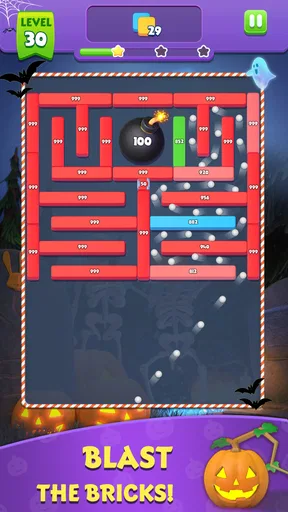
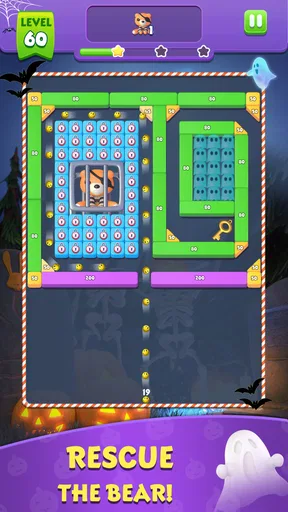
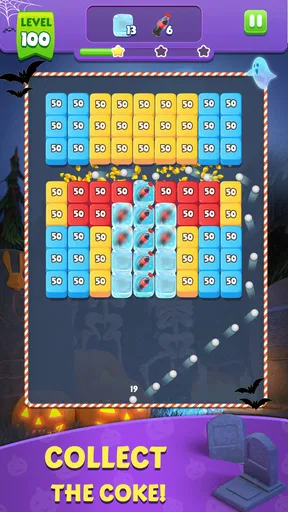
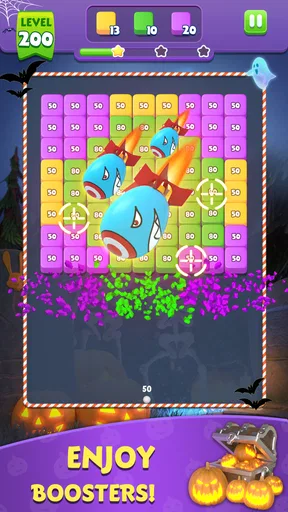
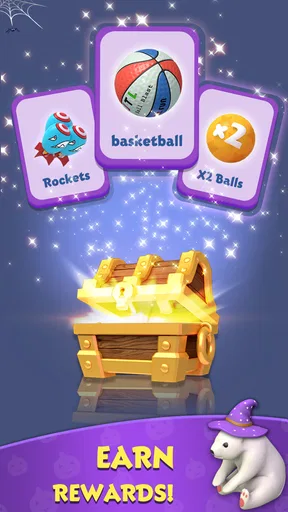
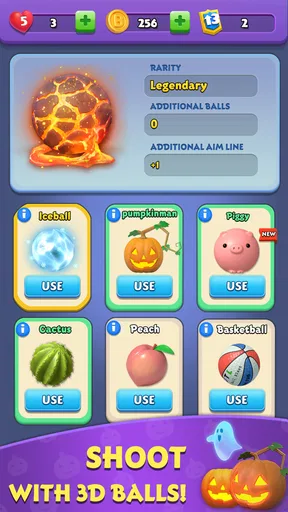
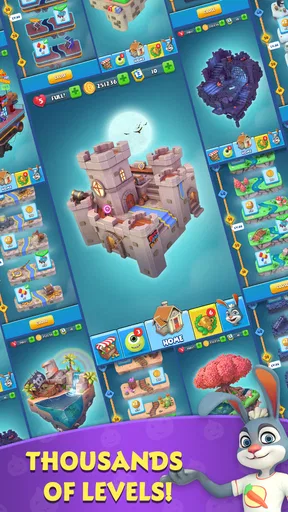
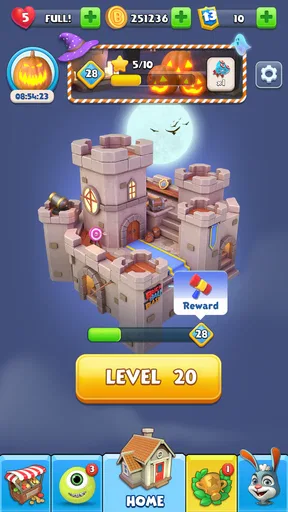
Our Review of Brick Ball Blast: Ball Crusher
 Analysis by Appyee
I downloaded Brick Ball Blast: Ball Crusher expecting a quick arcade distraction, and that is exactly where it makes the most sense. It is a free brick-breaking game from Neworld Games, built around aiming a shot, watching balls ricochet through a three-dimensional arrangement, and clearing as much of the board as possible. The idea is familiar, but the angled presentation gives each move a little more visual depth than a traditional flat brick breaker.
My first impression was that it is easy to understand without being completely mindless. You do not need a tutorial-heavy introduction or knowledge of a complicated story. You can pick it up during a short break, play a few rounds, and stop without feeling that you have abandoned a long campaign. At the same time, careless aiming quickly turns a promising board into a difficult one, so there is enough decision-making to keep the basic loop from becoming pure button pressing.
The important question is not whether this is a good arcade game in isolation. It is whether its particular style suits the way you want to play. If you enjoy short sessions, repeated attempts, and the satisfaction of improving a shot, I think it is worth trying. If you want a story, deep character development, competitive multiplayer, or a carefully structured adventure, this is probably the wrong download.
How I judged the game before recommending it
I looked at four things while playing: how quickly the controls make sense, whether aiming feels meaningful after the novelty fades, how well the game works in short everyday sessions, and whether its free-to-play structure gets in the way. Those criteria matter more here than narrative or visual variety because the entire experience depends on the quality of its repeated shot-and-clear rhythm.
The control concept is approachable. You aim, release, and let the balls do the work. The challenge comes from choosing an angle that hits useful surfaces rather than simply firing toward the most obvious brick. A shot can look excellent at the start and still produce a poor result if the remaining path does not create enough useful rebounds. That small distinction is what separates a thoughtful turn from random tapping.
I also paid attention to how much planning is practical on a phone. A puzzle can be technically strategic but unpleasant if it demands long calculations on a small screen. Here, the best decisions are usually visual and immediate: identify a vulnerable line, estimate the first bounce, and consider where the balls might return. You are not solving a formal physics exercise, but you are learning to read the board before committing.
That makes the game a better fit for people who like light strategy inside an arcade wrapper. It does not ask for the patience of a traditional puzzle game, yet it rewards players who pause for a moment instead of firing instantly. The most useful habit is to plan the return path, not just the opening impact. This is easy to overlook when the board is crowded and the visual action becomes busy.
The core loop is simple, but the angle changes the feel
Traditional brick breakers often place the player beneath a flat wall and make paddle control the main skill. This game shifts attention toward launching balls through a spatial arrangement. That difference gives each turn a more deliberate beginning. Instead of reacting continuously to a ball bouncing back and forth, I spend more time deciding whether the initial trajectory is worth the attempt.
The three-dimensional presentation also helps the game feel distinct from the simplest versions of the genre. It is not a radical reinvention, and anyone looking for an entirely new arcade system should keep expectations realistic. Still, the perspective makes the familiar act of breaking blocks feel less like clearing a spreadsheet of tiles and more like setting up a chain of impacts.
What I enjoyed most was the moment when a single well-placed shot kept finding productive angles. Those turns feel earned because the result follows from the line I selected. A weak shot, by contrast, exposes a common limitation of this type of game: once the balls are moving, much of the outcome is already committed. The skill is concentrated before release, so players who prefer constant control may find the rhythm passive.
The game therefore rewards restraint. I often improved by waiting an extra second to inspect the lower edges and possible rebound surfaces. Shooting at the most visible target is not always best. A less obvious opening can create a longer route and affect more of the board. This is one of the more satisfying discoveries because it turns a basic arcade action into a small exercise in spatial forecasting.
Why it works well in ordinary daily situations
I can see myself using this during a commute, while waiting for an appointment, or between larger tasks when I want something interactive but not emotionally demanding. The game does not require me to remember a complicated plot or coordinate with other people. I can focus on one board, make a series of decisions, and put the phone away when the moment ends.
That short-session quality is a genuine strength. Many mobile games try to pull the player into long routines, while this one is easier to approach casually. If you have ten spare minutes and want a game that starts quickly, the brick-breaking format is more convenient than a role-playing game or a multiplayer title that depends on a full match.
There is also a useful mental switch between fast and careful play. When I am tired, I can treat it as a simple reflex-free distraction and take obvious shots. When I feel more focused, I can study the arrangement and search for a better angle. The same basic system supports both moods, although the game is more rewarding when I give it at least a little attention.
Parents may also appreciate the straightforward premise and the Everyone content rating. That does not automatically make every aspect ideal for every child, since spending decisions and screen habits still depend on the household, but the game is easier to explain than an app built around frightening themes or complex social interaction. Its appeal is mainly mechanical: aim, bounce, and clear.
Small techniques that improve the experience
My first practical tip is to stop treating the nearest brick as the default target. I look for the shot that creates the most useful sequence after the first collision. Sometimes that means aiming at a side rather than the center, because a side impact can send the balls toward a denser group. The decision is not always obvious, but considering the second contact usually produces better turns.
Second, I try to protect future options. A spectacular immediate hit can be less valuable than a quieter shot that opens a lane for the next turn. This is especially important when the board begins to feel crowded. Clearing one area is useful, but clearing the wrong area can leave the remaining structure in an awkward position. Thinking about the next launch keeps the game from becoming a series of disconnected shots.
Third, I use the visual layout to estimate risk rather than chasing maximum destruction every time. A high-impact route may look attractive, but if it depends on several uncertain rebounds, it can produce a disappointing result. A more controlled line may remove fewer bricks immediately while leaving a better board afterward. That trade-off is subtle and gives experienced players something to refine beyond simple speed.
Finally, I avoid rushing after a successful turn. The satisfying sound and movement can encourage an automatic follow-up, but the next board deserves a fresh look. The game is at its best when I treat each launch as a separate problem. This approach also reduces frustration because a failed turn feels like a decision to learn from rather than a random punishment.
Where Brick Ball Blast stands against other arcade choices
Compared with a classic paddle-and-ball breaker, this game is more focused on pre-shot planning and less on continuous interception. Choose it if you prefer aiming a deliberate launch. Choose the traditional alternative if you enjoy controlling a paddle in real time and reacting to a ball’s changing position. Neither style is automatically better; they satisfy different kinds of arcade players.
It also differs from endless runners, where the main pressure comes from maintaining movement and reacting to obstacles at speed. Here, the tempo is calmer before the launch and more observational during the resulting chain. Someone who wants a constant stream of rapid reactions may find the action too measured. Someone who likes seeing one decision unfold may find it more comfortable.
Against match-three puzzle games, the comparison is about control and consequence. Match-three titles often encourage scanning for combinations across a grid. This game narrows the decision to trajectory, collision, and board shape. It can feel more direct and less cluttered, but it also offers fewer kinds of moves. If you want several puzzle systems working together, a match-three game may keep you engaged for longer.
Endless high-score arcade games can provide a stronger sense of personal best chasing, especially for players who enjoy immediate failure and rapid restarts. Brick Ball Blast: Ball Crusher is better suited to someone who wants the satisfaction of clearing structures through repeated aiming. Its challenge is not only surviving as long as possible; it is understanding how a shot changes the available space.
I would not select it as a replacement for a story-driven game, a deep strategy title, or a social competitive app. The appeal is narrower and clearer. It is a focused brick-breaking experience with a three-dimensional look, not a broad package of different activities. That focus is a benefit when you want exactly this kind of game and a limitation when you are hoping for variety.
What the free model means for a practical decision
The game is free to download, which makes testing the core experience straightforward. You do not have to decide whether the concept is worth paying for before trying it. That is important for a minimalist arcade title because the control feel is personal: some players will enjoy the deliberate aiming immediately, while others will find the repeated loop too narrow.
There are in-app purchases ranging from $0.99 to $99.99 per item. I would approach those carefully rather than assuming that spending will improve the underlying skill. The central satisfaction comes from choosing a better line, so purchases should be judged as optional convenience rather than a substitute for learning the board. If you are installing it for occasional play, setting a personal spending limit before starting is sensible.
This is also where the cost of switching matters. Trying it costs little in money, but it does cost storage space, attention, and possibly patience if the format does not match your taste. If you already have a brick breaker you love, the reason to switch is the three-dimensional aiming style, not because the basic concept is unfamiliar. If you are coming from runners or match-three games, give the launch rhythm a few sessions before deciding whether its slower planning suits you.
The game has an average rating of 4.5 from around 35 thousand ratings, with roughly 3.4 thousand written reviews. Those figures suggest that the format has found a substantial audience, but they should not replace personal testing. A popular arcade loop can still feel repetitive to someone who needs story, variety, or constant new mechanics.
Neworld Games has kept the title available for a broad audience, and it has passed one million installs. It was released on November 24, 2020, and the current version is 4.9.13. On Android, it requires version 7.0 or newer. Those details make it accessible to many existing devices, while the continuing version information is useful for anyone checking compatibility before downloading.
Limitations I noticed before making a recommendation
Repetition is the biggest concern. The basic action remains aiming and breaking, so the game depends on your willingness to improve within that loop. If you need a steady stream of new rules, changing characters, or a strong sense of progression, the simplicity may become tiring. I enjoyed the clarity, but I would not pretend that clarity automatically equals variety.
The other limitation is that the player’s control ends after the launch. Watching a good chain develop is satisfying, yet watching a poor chain unfold can feel helpless. Players who want to correct mistakes in real time may prefer a paddle game or a more active arcade title. This game asks you to accept the result of your setup and make a better decision next time.
Visual action can also make it harder to read the most useful route at a glance. The three-dimensional arrangement is part of the appeal, but it can add visual noise compared with a flat grid. I found that slowing down helped, especially when several possible rebounds competed for attention. If you prefer instantly readable boards, the perspective may feel like extra decoration rather than an advantage.
Finally, the purchase range means the free experience should be approached with awareness. I would not install it expecting every possible convenience to be included without interruption or pressure. Instead, I would first decide whether the basic game is enjoyable on its own. If it is not, paying will not solve the more fundamental mismatch between the player and the loop.
Who should install it, and who should skip it
I recommend it to casual arcade fans who like aiming, bouncing, and gradually improving their judgment. It is especially suitable for people who want a game that can fit into small gaps in the day without requiring a long commitment. It also works for players who enjoy visual cause and effect: you choose a line, the balls travel through the structure, and the resulting pattern gives you information for the next attempt.
I would also suggest it to anyone curious about a brick breaker that feels more spatial than the standard flat version. The difference is not enormous, but it is noticeable enough to justify a trial. The game’s strongest identity comes from that combination of familiar rules and a more dimensional board.
I would skip it if you want a demanding competitive environment, a story with memorable characters, or a large collection of unrelated mini-games. I would also skip it if repeated attempts at the same fundamental action usually bore you. A free download is not a reason to keep an app that does not fit your preferred pace.
For a child, I would make the decision together and discuss in-app purchases before handing over the device. The Everyone rating describes the broad content suitability, but it does not remove the need for sensible supervision around spending and play time. For an adult looking for a quick distraction, the main question is simpler: do you enjoy planning a trajectory more than reacting continuously?
My recommendation after playing
My final view is positive but specific. Brick Ball Blast: Ball Crusher is not trying to be an all-purpose mobile game, and it should not be judged as one. It is a focused arcade title that makes brick breaking feel a little more spatial through its three-dimensional presentation. The free entry point makes it easy to test, while the short-session structure gives it a practical place in a busy day.
I would install it before choosing another brick breaker if I wanted deliberate aiming, chain reactions, and a calm rhythm between launches. I would choose a paddle-based alternative for active reflex play, a match-three game for broader combination puzzles, or an endless runner for constant motion. That comparison captures the real decision better than calling one genre superior.
My advice is to play with patience, inspect the rebound route, and judge the game after you have stopped firing at the most obvious target. If that small planning challenge feels satisfying, the loop has enough character to keep you returning. If it feels repetitive even when you play thoughtfully, move on without feeling that you missed a hidden mode. For me, it earns a recommendation as a compact, approachable arcade game, provided you want focused brick breaking rather than a larger mobile adventure.
Verdict
Strengths of Brick Ball Blast: Ball Crusher
- Simple one-touch controls make it easy to start playing immediately.
- Short levels work well for quick gaming sessions on the go.
- Breaking multiple bricks at once creates satisfying chain reactions.
- Offline play is convenient when you have no internet connection.
- Gradually increasing difficulty keeps early stages accessible to newcomers.
Limitations of Brick Ball Blast: Ball Crusher
- Gameplay can become repetitive after extended sessions.
- Later levels may rely heavily on precise timing and repeated attempts.
- Power-up effects are not always easy to understand at first.
- Progression may feel slower without optional in-app purchases.
- Ad interruptions can reduce the pace between some gameplay rounds.
Similar Picks in This Category
View All
Subway Surfers
SYBO Games4.6

Stickman Party 234 MiniGames
PlayMax Game Studio4.6

Subway Princess Runner
Ivy4.4

Temple Run
Imangi Studios4.2

Zombie Tsunami
Mobigame SAS4.6

Stack Ball - Crash Platforms
CASUAL AZUR GAMES4.5
Frequently Asked Questions
What is Brick Ball Blast: Ball Crusher, and how is it played?
Brick Ball Blast: Ball Crusher is a casual arcade game focused on breaking numbered bricks with bouncing balls. You aim, launch a group of balls, and try to clear as many blocks as possible before they reach the bottom of the screen. Each turn requires planning your shooting angle, using walls for rebounds, and targeting blocks that could otherwise become difficult to remove.
Is Brick Ball Blast: Ball Crusher free to download and play?
The game is generally available as a free download, allowing players to begin playing without purchasing it upfront. However, the experience may include advertisements, optional in-app purchases, or other monetization features. These can potentially provide bonuses, remove advertising, or speed up progress. Before downloading, check the current store listing for pricing details and any purchase-related information.
Does the game require an internet connection?
Brick Ball Blast: Ball Crusher is designed primarily as a quick, pick-up-and-play experience, so many of its basic levels may be accessible without a constant internet connection. Nevertheless, an internet connection can be required for advertisements, rewards, updates, cloud-related features, or promotional content. Availability of offline play may vary by device version and future updates.
Is Brick Ball Blast: Ball Crusher suitable for children and casual players?
The game uses simple controls and an easy-to-understand brick-breaking concept, making it approachable for casual players and younger audiences. There is no complicated story or lengthy tutorial to learn. Parents should still review the app’s age rating, advertising practices, and optional purchases, since these details can change and may affect whether the game is appropriate for a particular child.
Are there many levels or challenges, and does the game become difficult?
The main challenge comes from clearing increasingly demanding brick arrangements while managing limited opportunities and choosing efficient angles. As you progress, blocks may require more hits and create tighter situations, encouraging careful planning rather than random shooting. The game is suitable for short sessions, although players looking for deep strategy, a narrative campaign, or highly varied gameplay may find the core mechanics repetitive over time.
Play our best games!


